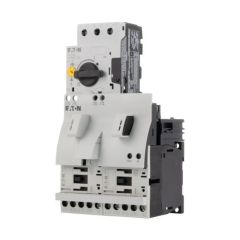
| CATALOG NUMBER |
283197 |
| Manufacturer |
Eaton Moeller |
| Product Name |
Eaton Moeller® series MSC-R Reversing starter |
| Catalog Number |
283197 |
| Model Code |
MSC-R-2,5-M7(24VDC) |
| EAN |
4015082831974 |
| Product Length/Depth |
185 mm |
| Product Height |
95 mm |
| Product Width |
90 mm |
| Product Weight |
1.04 kg |
| Certifications |
CSA-C22.2 No. 14-10 |
Product Name
Eaton MSC-R-2,5-M724VDC Overload Relay
Product Introduction
The Eaton MSC-R-2,5-M724VDC is a compact electronic overload relay designed for precise motor protection in low-current industrial applications. Part of Eaton’s MSC-R series, this relay is rated for 2.5 amperes and features a 24V DC control supply. It provides accurate protection against motor overload, phase failure, and phase imbalance, ensuring long motor life and minimizing unplanned downtime. The MSC-R-2,5-M724VDC is compatible with Eaton’s MSC series contactors, making it ideal for small motors, fractional horsepower drives, fans, pumps, and auxiliary equipment.
Product Description
The Eaton MSC-R-2,5-M724VDC is a precision electronic overload relay engineered to protect small three-phase AC motors from damage caused by thermal overload, phase loss, and current imbalance. Unlike traditional thermal overload relays that rely on bimetallic strips with inherent mechanical limitations, the MSC-R series employs advanced electronic current sensing and microprocessor-based evaluation. This technology provides more accurate protection, wider adjustment ranges, ambient temperature immunity, and additional diagnostic features not available with conventional overload relays. The MSC-R-2,5-M724VDC is specifically designed for use with Eaton MSC series contactors, creating a compact, high-performance motor starter combination suitable for a broad range of low-current applications.
The MSC-R-2,5-M724VDC is rated for a motor full load current range up to 2.5 amperes, making it suitable for small three-phase motors, fractional horsepower drives, and auxiliary equipment typically found in industrial, commercial, and infrastructure applications. This relay is ideal for protecting motors driving small fans, dosing pumps, conveyors, machine tool auxiliary drives, valve actuators, and HVAC equipment. The relay operates from a 24V DC control supply, which is the standard control voltage in many modern industrial automation systems using programmable logic controllers, distributed control systems, and other solid-state control devices. The low-voltage DC control interface simplifies integration with automation systems and enhances safety for personnel working on control panels, as 24V DC is considered safe for live troubleshooting.
The construction of the MSC-R-2,5-M724VDC reflects Eaton’s commitment to durability and reliability in demanding industrial environments. The housing is molded from high-dielectric, flame-retardant thermoplastic that meets UL 94 V-0 requirements, providing excellent resistance to impact, moisture, dust, and many industrial chemicals. The compact design allows the relay to mount directly onto the front or side of compatible MSC contactors, creating an integrated motor starter assembly that saves valuable panel space and reduces wiring complexity. The relay’s dimensions are standardized to fit within the same footprint as equivalent thermal overload relays, allowing straightforward upgrades from traditional bimetallic protection to electronic protection without panel modifications.
The electronic sensing technology used in the MSC-R-2,5-M724VDC provides significant advantages over bimetallic thermal overload relays. Three built-in precision current transformers continuously monitor the current in each phase of the motor supply. Even at low current levels down to fractional amperes, these current transformers provide accurate sensing. The microprocessor analyzes these current signals in real time, calculating the thermal state of the motor based on its actual load current, time, and the selected trip class. This electronic thermal model accurately simulates the heating and cooling characteristics of the protected motor, providing precise overload protection without the drift, ambient temperature sensitivity, or mechanical wear associated with bimetallic devices. The microprocessor performs thousands of calculations per second, ensuring that any fault condition is detected and acted upon within milliseconds.
The adjustment range of the MSC-R-2,5-M724VDC is set via a clear rotary dial on the front of the relay, typically adjustable from approximately 0.6 amperes to 2.5 amperes. This wide adjustment range allows a single relay model to protect motors of different horsepower ratings, from very small fractional horsepower motors up to approximately 1 horsepower at 480V or 0.5 horsepower at 230V. This flexibility significantly reduces spare parts inventory, as one relay model can serve multiple small motor sizes. The dial is clearly marked with current values, making it easy for electricians to set the correct full load current during installation, motor replacement, or load changes. A transparent hinged cover over the adjustment dial prevents accidental changes while still allowing visual verification of the setting without opening the cover.
The trip class of the MSC-R-2,5-M724VDC is selectable, typically offering Class 10, Class 20, or Class 30 protection curves. The trip class defines how quickly the relay will trip under locked rotor conditions, which is critical for matching the protection to the motor’s starting characteristics. Class 10 provides fast tripping for motors that start quickly or have low inertia loads, such as small fans, small pumps, and centrifugal machines. Class 10 is also suitable for motors that are started frequently, as it minimizes thermal stress. Class 20 is suitable for normal industrial motors with moderate starting times. Class 30 is used for higher inertia loads such as small conveyors starting under load or valve actuators with longer travel times. The ability to select the trip class in the field using a simple switch allows the same relay to be optimized for different applications without changing hardware, providing exceptional flexibility for low-current applications.
Phase failure and phase imbalance protection are integral features of the MSC-R-2,5-M724VDC. If one phase of the three-phase supply is lost due to a blown fuse, loose connection, or contactor failure, the small motor will continue to run on two phases. In this condition, the motor draws excessive current in the remaining phases and can burn out within minutes. The electronic relay detects this condition by comparing the three phase currents and trips within a few seconds, preventing motor damage. Phase imbalance protection trips the relay when the current difference between phases exceeds a preset percentage, typically around 30% to 50%. This feature detects developing problems such as a poor electrical connection, a failing motor winding, or unequal supply voltages before they cause a complete phase loss or motor failure. This is particularly important for small motors that may be located in remote or inaccessible locations.
The MSC-R-2,5-M724VDC includes a normally closed contact for tripping the contactor coil and a normally open contact for signaling. When the relay detects an overload, phase failure, or imbalance condition, the normally closed contact opens, de-energizing the contactor coil and disconnecting the motor from the supply. This action removes power from the motor, stopping it safely. Simultaneously, the normally open contact closes, providing a dry contact signal to a PLC input, indicator light, alarm horn, or building management system. This signal can be used for remote indication of a fault condition, allowing operators to respond quickly from a central control room. The contacts are electrically isolated from the sensing circuit and from the control supply, allowing them to be used at different voltages, typically up to 250V AC or 125V DC.
The relay also includes a manual or automatic reset selector, typically a small switch on the front panel. In manual reset mode, the relay must be physically reset by pressing a button on the front of the relay after a trip. This mode ensures that an operator investigates the cause of the trip before restarting the motor, which is important for safety and for preventing repeated damage. In automatic reset mode, the relay will automatically reset after a cooling period, typically after the electronic thermal model indicates that the motor has cooled sufficiently. Automatic reset can be useful for remotely located or unattended equipment where a manual reset would require a site visit, such as ventilation fans in remote buildings or pumps in isolated lift stations. The reset mode is selected via the switch, and the reset button is large, accessible, and clearly marked.
The MSC-R-2,5-M724VDC includes a trip indicator that provides clear visual confirmation when the relay has tripped. Typically, a red flag or bright LED illuminates to indicate a fault condition, and the indicator remains visible even after the relay has cooled and is ready to reset. Some versions also include a separate indicator for control power present. This feature helps maintenance personnel quickly identify which motor starter has tripped in a multi-starter panel, dramatically reducing troubleshooting time. When walking through a large motor control center with dozens of starters, the visible trip indicator allows electricians to locate the tripped starter at a glance, which is especially valuable when the tripped motor is small and not immediately noticeable from process indicators.
Electrical connections to the MSC-R-2,5-M724VDC are made via screw terminals that accept standard control wiring sizes. The terminals for the current monitoring circuit are sized for the small motor power conductors, typically accepting up to #14 AWG or #16 AWG copper wire. The control terminals are smaller and accept wire sizes common for 24V DC control circuits, typically #26 AWG to #14 AWG. Terminal labeling is clear, permanent, and molded into the housing, reducing wiring errors. The relay includes finger-safe terminal shrouds to prevent accidental contact with live parts when the panel door is open, meeting safety standards for dead-front construction.
The MSC-R-2,5-M724VDC operates over a wide ambient temperature range, typically from -25°C to 60°C, making it suitable for use in unconditioned industrial environments, outdoor enclosures, and buildings without climate control. Unlike bimetallic relays, which can have their trip characteristics significantly affected by ambient temperature, the electronic MSC-R relay is largely immune to ambient temperature variations within its specified range. This provides consistent protection regardless of whether the panel is in a hot foundry, a cold warehouse, or an outdoor enclosure exposed to weather.
Product Advantages
The Eaton MSC-R-2,5-M724VDC electronic overload relay offers numerous significant advantages over traditional bimetallic thermal overload relays, particularly for low-current, fractional horsepower motor applications. The most important advantage is the accuracy and repeatability of the electronic sensing system at low current levels. Bimetallic relays become increasingly inaccurate at low current settings due to the small physical deflections involved and the effects of ambient temperature. The MSC-R relay uses precision current transformers and a microprocessor, providing consistent trip accuracy within tight tolerances regardless of the set current. This accuracy ensures that small, often critical motors are properly protected without nuisance tripping.
Another major advantage is the ambient temperature immunity. Small motors are often located in environments with wide temperature variations – outdoor fans, rooftop equipment, unheated warehouses, or refrigerated spaces. A bimetallic relay that is accurate at 20°C may trip at a significantly different current level at 40°C or 0°C. The MSC-R electronic relay is unaffected by ambient temperature within its specified range, providing the same protection whether the motor is running in a freezer or on a hot roof. This is particularly valuable for fractional horsepower motors that may have limited thermal reserve.
The selectable trip class is another significant advantage. Small motors can have very different starting characteristics. A small fan may start in less than a second, while a small conveyor or valve actuator may take several seconds to accelerate. With a bimetallic relay, the trip class is fixed. The MSC-R-2,5-M724VDC allows the user to select Class 10, Class 20, or Class 30 protection curves, allowing the same relay to be optimized for each application. This flexibility reduces spare parts inventory.
Phase failure and phase imbalance protection are included as standard features, whereas many small bimetallic overload relays provide little or no phase loss protection. A small motor running on two phases can burn out in minutes, but the reduced heating may not trip a bimetallic relay quickly. The MSC-R electronic relay actively monitors all three phases and trips within seconds of a phase loss or imbalance, preventing motor burnout. This feature alone can save the cost of the relay many times over.
The integrated auxiliary contacts simplify control circuit wiring. Separate auxiliary contact blocks are not required, reducing panel space and installation labor. The signaling contact can be wired directly to a PLC input, allowing remote monitoring of motor trips. For small, distributed motors in remote locations, this remote indication is invaluable.
The manual/automatic reset selector provides flexibility. For critical but remote equipment such as small ventilation fans, automatic reset can keep the fan running without a site visit. For safety-critical equipment, manual reset ensures an operator investigates the cause of the trip.
The clear trip indication and visible reset button simplify troubleshooting. In a panel with many small motor starters, the red trip indicator is immediately visible, allowing quick identification of the tripped motor without opening doors or checking each starter individually.
The direct mounting to Eaton MSC series contactors creates a compact, pre-wired motor starter assembly. This is particularly valuable for small motors where panel space is often limited. The integrated assembly occupies minimal space and reduces assembly time.
Finally, the MSC-R-2,5-M724VDC offers excellent long-term reliability. With no moving parts in the sensing mechanism, there is nothing to wear out or drift over time. The sealed electronic components are protected from dust, moisture, and vibration. The relay will provide consistent protection for the life of the equipment.
Application Scenarios
The Eaton MSC-R-2,5-M724VDC electronic overload relay is used in a wide range of industrial, commercial, and infrastructure applications requiring reliable protection for small three-phase motors up to approximately 1 horsepower.
In industrial manufacturing, the MSC-R-2,5-M724VDC protects small auxiliary motors on machine tools, including coolant pumps, lubrication pumps, chip conveyors, and tool changers. A CNC machining center might have a 0.5HP coolant pump motor that runs whenever the spindle is active. The relay’s fast Class 10 setting is appropriate for the pump’s quick-starting characteristics. The auxiliary contact provides a signal to the PLC if the coolant pump trips, allowing the machine to generate an alarm and potentially stop the spindle to prevent overheating of the cutting tool.
HVAC systems use the MSC-R-2,5-M724VDC to protect small fan motors, damper actuators, and pump motors in air handling units, variable air volume boxes, and fan coil units. A variable air volume box in a commercial building might have a small fan motor of 0.25 to 0.5 horsepower. The relay’s ambient temperature immunity ensures consistent protection whether the VAV box is in a hot mechanical room or a cold ceiling plenum. The 24V DC control supply is compatible with the building automation system’s low-voltage control outputs.
Water and wastewater treatment plants use the MSC-R-2,5-M724VDC on small chemical feed pumps, samplers, agitators, and valve actuators. A chemical metering pump might have a 0.33HP motor driving a diaphragm pump. The relay’s phase imbalance protection is valuable in these applications, as a poor connection in a corrosive environment can cause imbalance long before a complete phase loss. The manual reset mode is typically used to ensure an operator investigates before restarting a chemical feed pump.
Agricultural facilities use the MSC-R-2,5-M724VDC on small grain augers, ventilation fans, feed augers, and door openers. A livestock barn might have small exhaust fans of 0.5HP each, with dozens of fans distributed throughout the facility. The relay’s automatic reset mode can be used to keep fans running without site visits, while the clear trip indicator helps farm personnel identify which fan has stopped. The ambient temperature immunity ensures reliable protection in unheated barns.
Commercial refrigeration systems use the MSC-R-2,5-M724VDC on evaporator fan motors in walk-in coolers and freezers. A walk-in freezer might have three 0.25HP evaporator fans. The relay’s small size fits within the cramped control compartment of the refrigeration unit. The automatic reset mode can be used for remote freezers, but care must be taken to ensure safety. The precise electronic protection is important for preventing fan motor burnouts that could lead to evaporator icing and temperature excursions.
Conveyor systems use the MSC-R-2,5-M724VDC on small transfer conveyors, belt feeders, and vibratory feeders. A small transfer conveyor in a packaging line might have a 0.75HP motor. The relay’s selectable trip class allows Class 20 or Class 30 to be selected for conveyors starting under load. The auxiliary contact signals the PLC when the conveyor trips, allowing the system to stop upstream feeding.
Machine guarding and access control systems use the MSC-R-2,5-M724VDC on gate operators, door operators, and barrier arm motors. A parking garage gate operator might have a 0.5HP motor. The relay protects the motor from overloads caused by binding or obstructions. The manual reset mode ensures that an operator investigates the cause of a trip before resetting the gate.
Laboratory equipment uses the MSC-R-2,5-M724VDC on shakers, mixers, centrifuges, and environmental chamber fans. A laboratory centrifuge might have a 0.75HP motor. The precise electronic protection is important for protecting expensive laboratory equipment. The auxiliary contact can be wired to the laboratory’s monitoring system to log motor trips.
Finally, renewable energy systems such as solar tracking systems use the MSC-R-2,5-M724VDC on small AC motors that position solar panels. A solar tracker might use a 0.25HP motor to adjust panel angles throughout the day. The relay protects the motor from overloads caused by binding or mechanical jams. The low 24V DC control supply is compatible with the solar system’s control voltage derived from batteries.
FAQ
Q: What is the current rating of the MSC-R-2,5-M724VDC?
A: The relay is rated for motor full load currents up to 2.5 amperes, with an adjustable range typically from approximately 0.6A to 2.5A.
Q: What control voltage does this relay require?
A: The MSC-R-2,5-M724VDC operates from a 24V DC control supply.
Q: What size motors can this relay protect?
A: At 480V, the relay can protect motors up to approximately 1 horsepower. At 230V, it can protect motors up to approximately 0.5 horsepower.
Q: What contactors are compatible with this relay?
A: The relay is designed for direct mounting onto Eaton MSC series contactors of appropriate frame size.
Q: What trip classes are available?
A: The relay offers selectable trip classes, typically Class 10, Class 20, and Class 30, selectable via a switch on the front.
Q: Does this relay provide phase loss protection?
A: Yes, phase failure and phase imbalance protection are included as standard features, which is especially important for small motors.
Q: Can the relay be manually or automatically reset?
A: Yes, the relay includes a selector switch for manual or automatic reset mode.
Q: Is the MSC-R-2,5-M724VDC affected by ambient temperature?
A: Unlike bimetallic relays, the electronic MSC-R relay is largely immune to ambient temperature variations within its specified operating range of -25°C to 60°C.